
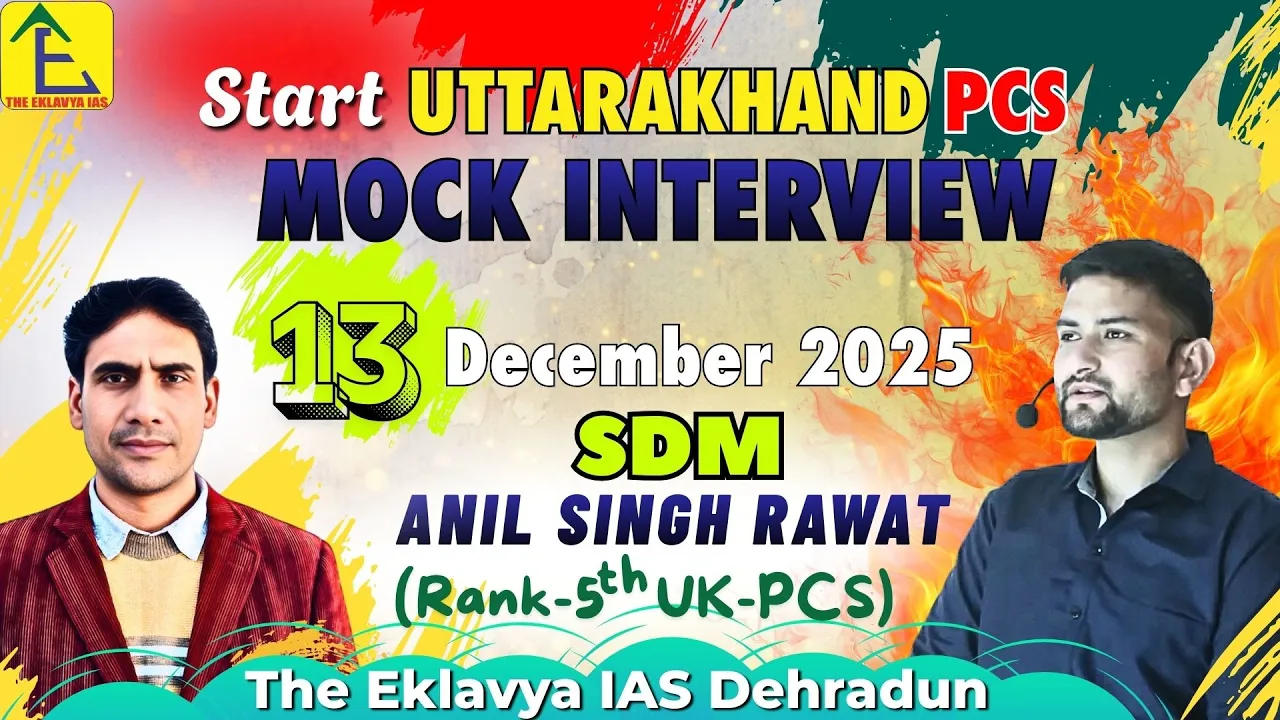
Uttarakhand PCS Interview

How and Why to Prepare at The Eklavya IAS Academy, Dehradun for the Uttarakhand PCS Interview
Preparing for the Uttarakhand Public Service Commission (UK PCS) interview is the last and perhaps the most human stage of a long, arduous selection process. It tests not just what you know, but who you are: your presence, clarity, judgement, values and the way you respond under pressure. Choosing the right place and plan to prepare for this final hurdle can make a disproportionate difference. Many aspirants select coaching institutes in Dehradun because of the city’s calm environment, competitive peer group and concentrated civil services ecosystem. The Eklavya IAS Academy in Dehradun is one of the names aspirants often consider; whether you choose Eklavya or another serious academy, the principles of smart, disciplined, holistic interview preparation remain the same. This blog explains why coaching at a place like Eklavya can help, and then provides a detailed, practical, step-by-step plan you can follow to approach the UK PCS interview confidently and effectively. Starting 13 December
Why choose a Dehradun academy like The Eklavya for interview preparation
There are three broad reasons candidates opt for an institute-based interview program rather than only self-study: structured feedback, realistic practice, and the peer environment.
Structured feedback is the single most valuable advantage. In one-on-one mock interviews and group sessions you get immediate, actionable comments on tone, body language, answer structure and content. Teachers have seen hundreds of aspirants and can quickly identify weak habits — excessive verbosity, repeating points, not answering the question directly, nervous mannerisms — and give precise drills to fix them. That kind of focused calibration is hard to recreate alone.
Realistic practice helps you get used to the interview pressure. Professional mock panels recreate the formal setting, the pressure of a tough follow-up, quick-fire questions and the uncertainty of transitions between topics. The more realistic the simulation, the less the real interview will rattle you. Dehradun academies routinely run back-to-back mocks with different panel styles, which helps you build adaptability.
Finally, the peer environment is energizing and informative. Watching others during mock sessions, hearing their answers, seeing diverse approaches to the same question, and discussing current affairs over tea are important learning channels. Good centers attract a focused peer group — serious aspirants with good feedback loops — and that social input keeps your preparation grounded and competitive.
Beyond these core benefits, an institute often provides resources useful for interview stage: curated current affairs capsules, a stock of probable questions, dossier and bio-data formatting help, and sometimes access to counselors who help with mental conditioning and communication skills. If The Eklavya or another Dehradun academy matches your budget and schedule, consider a short, intensive interview-prep course there; if not, you can still adapt the methods I describe and run your own mock panels.
What the UK PCS interview expects: mindset and profile
Before diving into practical steps, internalize what the interview is designed to examine. The panel assesses your mental alertness, clarity of thought, balance of judgement, moral integrity, leadership potential and effective communication. They also check your knowledge of Uttarakhand — its geography, economy, culture, administrative issues and developmental challenges — as well as national and global current affairs. Your educational background, work experience and extracurricular achievements will be discussed to verify authenticity and evaluate how your profile can translate into administrative competence.
Adopt this mindset: you are an intelligent, responsible potential public servant. Your answers should be honest, concise, structured and steeped in administrative sensibility. Avoid grandstanding or rehearsed sermons. The panel values calm confidence, humility and the ability to admit uncertainty while indicating how you would find answers or implement solutions.
A six-stage preparation plan (what to do, and when)
Below is a practical, time-phased plan that you can adapt to your remaining timeline. Imagine you have roughly eight weeks before the interview; the schedule will scale nicely for shorter or longer durations.
Stage 1 — Orientation and dossier (Week 1)
Start by polishing the administrative essentials and your personal dossier. Draft a crisp bio-data that follows the UPSC/UK PCS format: personal details, educational qualifications, work experience, extra-curriculars, awards, publications and contact history. Your dossier should also include a one-page personal profile summarizing your background, strengths, motivations and service orientation; this is what many panels refer to during the initial conversation.
Simultaneously, prepare a “hobby & accomplishments” narrative. For each hobby or achievement — whether mountaineering, debate, social work, research — be ready to talk about specifics: when, where, numbers, lessons learned, people you worked with, problems faced and outcomes. Vague statements (“I love reading”) don’t help; concreteness demonstrates responsibility and initiative.

Stage 2 — Audit your static knowledge & state issues (Week 2)
Make a quick audit of your “static” knowledge: basic facts about Uttarakhand — districts, economy (tourism, hydropower, agriculture), key rivers and lakes, major infrastructure projects, forest and wildlife issues, tribal communities, and administrative challenges like disaster management (landslides, floods), migration and urbanization. Prepare succinct notes: one page per major topic with salient facts, key figures and two or three analytical points about policy response and governance.
This stage is also when you should prepare your study plan for current affairs. Decide which newspapers and magazines you will rely on (daily national newspaper, regional paper, monthly magazines, official reports). The aim is not encyclopedic knowledge but the ability to link current developments to administrative consequences for Uttarakhand.
Stage 3 — Subject deepening & mock framework (Weeks 3–4)
Deepen your knowledge in areas you expect to be asked about and construct an organized answer framework. Spend focused time on:
• Governance and public administration basics: schemes (MNREGA, PMAY etc.), local governance (Panchayati Raj), disaster management architecture (NDMA, SDMA), and law & order dynamics.
• Economy and development: state finances, sources of revenue for Uttarakhand, tourism management and sustainable tourism models, hydropower economics, agriculture policy, and challenges of hill development.
• Environment and forest policy: human-wildlife interface, biosphere reserves, forest rights, impact of infrastructure on fragile ecosystems.
• Inter-state and international issues: water sharing, border management (if relevant), and cross-border environmental impacts.
Meanwhile, set up your mock interview framework. If you’re at Eklavya, they will provide panels; if you’re self-organizing, assemble a mock panel of three people: one senior (administrative or academic), one subject expert (economics/ environment/ law) and one HR-style panelist (to probe personality and situational questions). Schedule 2–3 mocks per week.
Stage 4 — Intensive mock interviews and feedback loop (Weeks 5–6)
Move into intensive practice. After each mock, record the session on audio or video. Review it with your mentor and identify repetitive weaknesses: filler words, lack of eye contact, excessive reliance on notes, disorganized answers. Work on micro-skills: breathing, pacing, posture, and transitions between points.
Use specific drills: practice opening answers in one or two lines, then divide the response into three crisp points and conclude with a practical suggestion or policy implication. For example, a question on sustainable tourism: start with a one-line thesis, present three interconnected concerns (carrying capacity, waste management, community participation), and finish with a one-line administrative recommendation (zonal carrying-capacity plans with community-run waste management).

Stage 5 — Personality & situational training (Week 7)
This week is about behavior under situational stress. Expect hypotheticals: “You are DC of a hill district and a landslide has cut off a village—what will you do?” Use structured administrative answers: immediate actions (rescue, relief, medical), medium-term measures (temporary shelter, restoring connectivity), coordination (NDMA/SDMA, Army, NDRF), communication strategy (relatives, media) and post-disaster planning (resettlement, hazard mapping).
Review ethics and decision-making frameworks. Panels often probe value-based dilemmas; your answers should reflect integrity, account for multiple stakeholders and show administrative feasibility. Practice giving balanced answers when pressed: concede limits, show empathy, propose transparent processes and accountability mechanisms.
Stage 6 — Final polishing & mental readiness (Week 8)
In the last week, taper content creation and focus on consolidation: revise your dossier, re-run 2–3 full mocks under exam-like timing, refine opening and closing statements, and rehearse travel and logistics to ensure punctuality. Do light reading. Avoid learning new heavy topics at the last minute.
Most importantly, manage sleep, diet and mental state. Short, regular light exercise and breathing exercises help. Visualize the interview process positively: entering the room, greeting the chair, sitting calmly, and answering questions with clarity.
How to structure answers: a simple, effective template
A reliable answer structure saves you in the moment. Use this four-part template:
One-line thesis: State your direct answer or stance in one succinct sentence. This shows clarity.
Explanation/definition: Briefly explain important terms or context (10–15 seconds).
Three-point body: Provide up to three solid points or arguments, each backed with an example, statistic, or administrative implication.
Concluding recommendation: End with a short, implementable takeaway or policy recommendation.
This structure helps you avoid meandering answers and shows the panel you can think and communicate like an administrator.
Building a strong current affairs routine for the interview
For the interview, current affairs should be used to illustrate analytical depth and administrative thinking. Your routine should cover national papers, regional coverage for Uttarakhand issues, government releases and basic international developments.
Prioritize depth over breadth. For every major news item practice asking: what happened, why it matters for Uttarakhand, what are the administrative implications, who are the stakeholders, and what actionable steps a district magistrate or state government might take. Maintain a “one-pager” for 10–12 crucial topics where you list causes, stakeholders, immediate steps and medium-term policy options. This one-pager will be your quick refresher before the interview.
Communication skills and language choice
Be comfortable answering in the language in which you feel most expressive, whether Hindi or English. Clarity, not flamboyance, matters. Avoid long rhetorical flourishes. Use simple, precise sentences. If you are asked a question in Hindi and you prefer to answer in English, ask politely: “May I answer in English?” Panels usually accept that.
Improve voice modulation and pacing. Talk neither too fast (shows anxiety) nor too slow (appears uncertain). Use pauses to gather thoughts; they are preferable to filler sounds. Practice with recording devices and ask mentors for focused feedback on tone and diction.
Body language, dress and etiquette
Your non-verbal cues matter. Sit upright, maintain a comfortable but not aggressive posture, make appropriate eye contact with all panelists, and use minimal hand gestures to accentuate points. Avoid fidgeting, tapping pens, or looking away frequently.
Dress conservatively and formally. For men, a neat shirt and trousers or a suit; for women, a simple saree or formal suit/salwar-kameez. Neutral colors are preferable. Comfortable, polished shoes are important because small discomforts can distract you.
Greet the panel politely, offer thanks when appropriate and address the chair if needed. If you don’t know an answer, be honest: say you don’t have the precise data but outline a practical way to get it. Speculation without humility looks poor.
Dossier and documents: prepare exhaustively
Carry a neat folder with photocopies of your certificates, mark sheets, domicile, caste (if relevant), experience letters and a copy of your bio-data. Keep originals in a safe file. Panels sometimes ask to see specific certificates or clarify gaps in your CV, and immediate access projects organization and honesty.
Do not volunteer unnecessary documents. If you have publications or special reports, carry copies but don’t overwhelm the panel unless asked.
Sample question bank and approach (practice with variety)
Practice a balance of questions: personal, state-specific, national policy, international affairs, ethics, and situational. Examples include:
“Tell us about your upbringing and why you want to join the civil services?” — Answer with a personal story linked to public service motivation; be specific about experiences that shaped you.
“What are the main economic challenges facing Uttarakhand and how would you address them as a collector?” — Use facts about tourism dependence, seasonal employment, migration; propose short-term cash-for-work schemes, promote value-added agriculture, skill training and sustainable tourism with carrying capacity limits.
“How should the state balance infrastructure development with environmental protection in Uttarakhand?” — Discuss environmental impact assessments, participatory land-use planning, green infrastructure, compensation for displaced communities and robust governance frameworks.
“If a media report accuses your office of negligence, what would you do?” — Stress immediate investigation, transparent communication, remedial steps, and independent audit if necessary.
For each mock, vary panel attitudes: gentle, skeptical, rapid-fire, or meticulously inquisitive. Practice staying grounded across styles.
Mental conditioning: stress, resilience and ethical steadiness
Interview is a high-pressure performance. Small breathing exercises before entering the room (deep diaphragmatic breaths, box breathing) calm nerves. Have a neutral pre-interview ritual: a small walk, a song snippet, or a cup of tea. Avoid last-minute debates or negative comparisons with peers.
Build resilience by reframing anxiety as focus energy. Remember: rejection is not a verdict on your worth. Treat every mock and interview as a feedback loop. Develop a learning mindset: be curious about why a panelist pressed a point rather than defensive.
Ethical steadiness is non-negotiable. Panels probe integrity and whether you will adhere to rule of law. Your answers should show fairness, respect for human rights and a commitment to institutional processes.
Logistics: travel, reporting and timing
If you are attending an in-person interview in Dehradun, or traveling to Dehradun for coaching, plan logistics carefully. Confirm dates, venue, reporting time and required documents well in advance. For Dehradun-based institutes, plan to stay near the coaching center or in the city center to avoid travel stress before mocks. Factor in local commute times and traffic. If interviews are in another city, rehearse travel, lodging and time-zone adjustments.
Final checklist before the interview
On the day or two before the interview ensure: dossier is organized, clothes are ready, you’ve reviewed one-pagers on state issues and current affairs, you have had a light exercise, you slept well and you have a calm mental routine. Avoid cramming.
If you can afford coaching at Eklavya: how to maximize those weeks
If you join a short Eklavya interview program, use the time ruthlessly. Attend all mock panels, request detailed written feedback, use recorded sessions for self-review, participate in group feedback meetings, practice in peer-to-peer mocks outside scheduled sessions, and ask mentors for tailored question banks focused on Uttarakhand. Take advantage of any profile building or dossier workshops and use the institute’s local contacts to gather state-specific data or case studies you can cite in answers.
Conclusion: blend coaching with disciplined self-work
A coaching institute supplies structure, panels and feedback. The real work happens in how you use that input: by revising your dossier, refining answer frameworks, deepening state-specific knowledge and mastering the human skills — presence, clarity, empathy and composure. Whether or not you choose The Eklavya IAS Academy in Dehradun, follow a rigorous plan with deliberate practice, mock interviews, targeted content revision and mental conditioning. The panel is looking for a person who combines knowledge with judgement and the willingness to serve.
The interview is not a trial to be feared but an opportunity to tell the story of who you are and how you would act as a public servant. If you prepare with honesty, discipline and humility, you won’t just be better positioned to clear the UK PCS interview — you’ll be better prepared for the real work of administration that follows.
Good luck — prepare smart, practice relentlessly, and stay steady. If you’d like, I can prepare a tailored eight-week study calendar, a printable one-pager template for Uttarakhand topics, and a mock-question set customized to your background. Which of those would help you next?
[…] 5. मानसिक तैयारी: आंतरिक खेल […]
[…] 3.5 अर्थव्यवस्था: पर्यटन, ऊर्जा और आयुष […]
[…] 3.3 अर्थव्यवस्था: पर्यटन, ऊर्जा और आयुष […]