
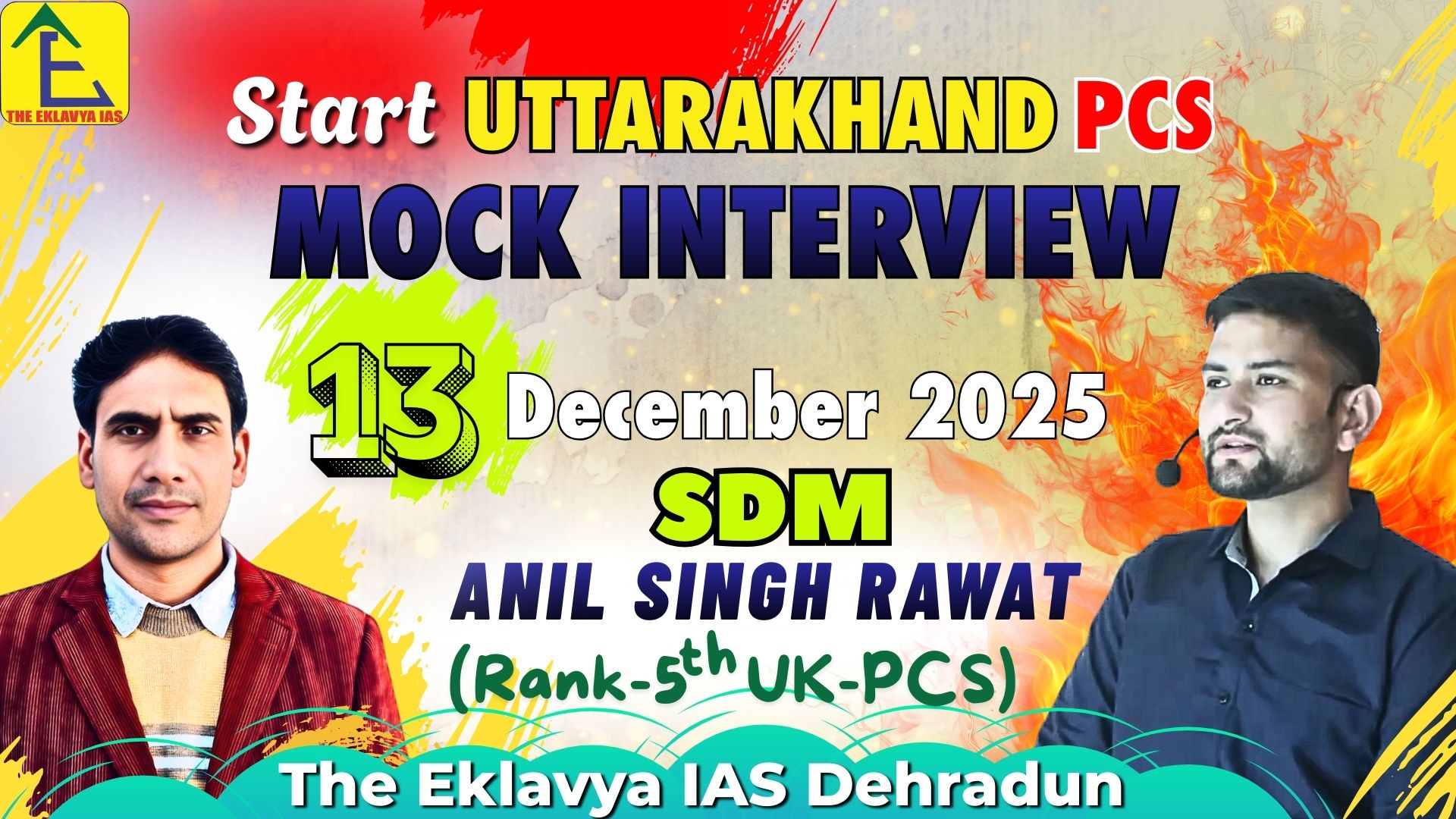
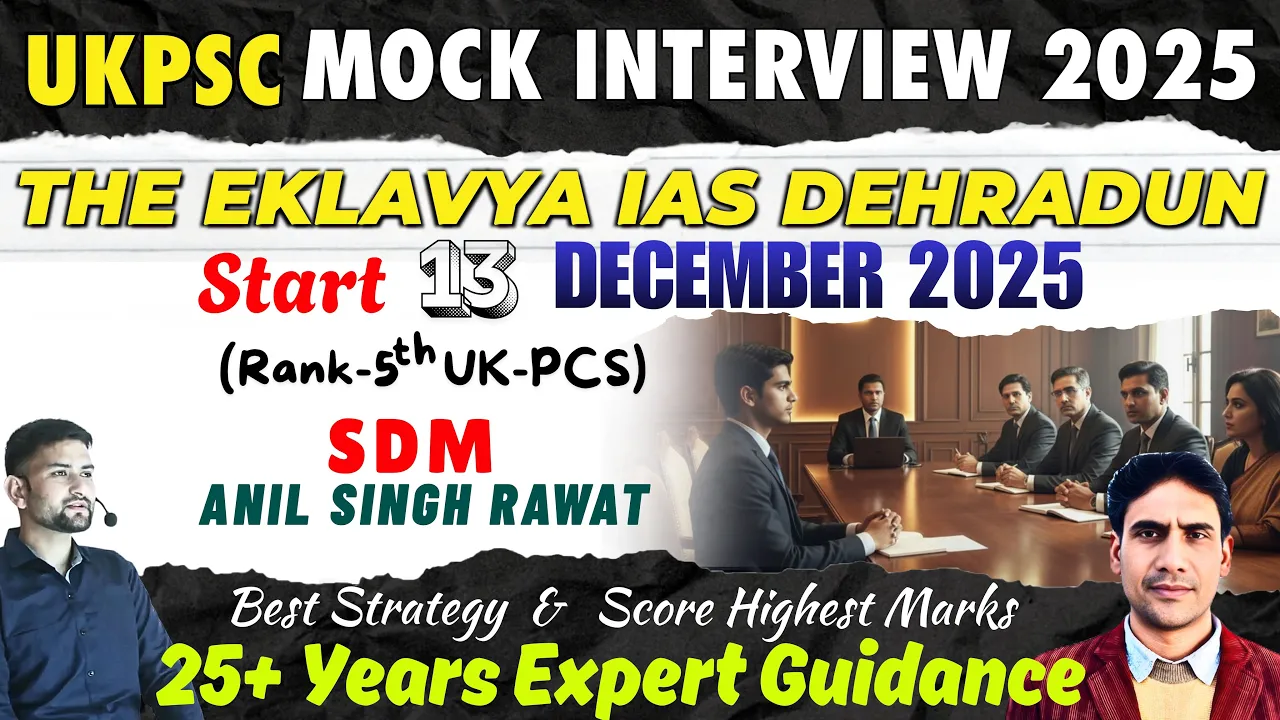
Uttarakhand PCS Mock Interview 2025 | Starting 13 December
How The Eklavya IAS Academy, Dehradun Is the Best Choice to Prepare for the Uttarakhand PCS Mock Interview 2025
The Civil Services Interview is where months — even years — of study meet the test of personality, judgement and presence. For the Uttarakhand PCS aspirant, that test has an extra layer: the panel will probe your knowledge of the state, local governance, hill-specific issues, disaster management, eco-sensitive administration and the practicalities of serving in remote, often fragile, terrains. Choosing where to prepare for that final, decisive round matters. If you’re weighing options, here’s a careful look at why The Eklavya IAS Academy in Dehradun is one of the most sensible, practical and high-impact choices for UKPSC Mock Interview 2025. preparation — and how to get the most from it.

1) Location advantage: Dehradun as an interview-prep ecosystem
Dehradun isn’t just a calm hill city; it’s become a concentrated centre for civil services aspirants. The city offers a quieter environment than metro centres, yet it has sufficient academic resources, libraries, mentors and a culture of disciplined preparation. For Uttarakhand PCS specifically, Dehradun offers two unique advantages: proximity to the state administrative culture and easy access to state-specific resource material. The Eklavya is located in this milieu, so you get the quiet focus you need without being cut off from state-level knowledge networks, newspapers, local contacts, and fellow aspirants who are simultaneously thinking, researching and rehearsing Uttarakhand-oriented questions.
2) Uttarakhand-focused curriculum and state-contextual training
The PCS interview is rarely generic. Panels want to see whether you understand Uttarakhand’s geography, economy, social challenges, local governance mechanisms, disaster risk profile, forest and water issues, tourism and migration patterns. The Eklavya’s programs are designed with that specificity in mind. Their interview modules focus on the contours that matter for a hill-state administrator: hydropower politics, carrying-capacity of hill towns, Van Panchayats, seasonal migration, land-use policy, disaster management (landslides, cloudbursts), eco-tourism models and rural livelihoods. You won’t get a one-size-fits-all “civil services” checklist — you’ll get tailored dossiers, state-briefs and scenario drills that simulate the kinds of real questions likely to come up in a UKPSC Mock Interview 2025.
3) Mock interviews modelled on the real panel
The single most important ingredient in any interview program is realistic mock panels. The Eklavya emphasizes frequent, varied, and high-fidelity mock interviews. These aren’t just polite Q&A sessions; they replicate panel dynamics — the chairperson setting the tone, a probing subject-expert, a testing administrative-style member and rapid-fire follow-ups that test mental composure. Mocks vary in temperament: some are softly inquisitive; others are deliberately abrupt or skeptical — both styles are essential practice. Recording and review are standard: you get the exact footage, detailed feedback from the panel and actionable drills. Repeating these cycles is what converts scripted answers into adaptive thinking.
4) Faculty with practical administrative and interview experience
A good interview trainer is not only a current-affairs expert but someone who understands administrative realities. The Eklavya incorporates faculty who have worked in administration, served in mentoring roles or have a track record of successful interview coaching. That matters because the panel is measuring “administrative sense” — how you would behave as a district magistrate faced with a landslide, an epidemic or a communal flare-up. Trainers at Eklavya guide you in framing answers that are not merely academic but operational: immediate steps, coordination with agencies, communication strategy, community outreach and medium-term plans.Uttarakhand PCS Interview Guidance at The Eklavya IAS Dehradun.
5) Strong focus on dossier, bio-data and narrative-building
In PCS interviews, your biodata and the stories you carry about your life shape the first six to eight minutes of the interaction.The Eklavya gives considerable weight to dossier building: crafting a crisp, honest bio-data; preparing narratives for your hobbies, special projects, work experience and travel; and rehearsing the “why public service” story so it sounds authentic rather than canned. Their approach is practical: quantify achievements, prepare specific anecdotes, anticipate likely follow-ups and make sure your narrative aligns with administrative aptitude — willingness to work in remote posts, empathy for marginalised groups, or experience with community mobilisation, for example.
6) State-specific current affairs and policy briefings
National current affairs alone won’t win you anUttarakhand PCS Mock Interview 2025. You must be able to connect national policy with local impact. The Eklavya provides compact, regularly updated Uttarakhand briefs: changes in state budgets, hydropower agreements, inter-state river issues, forest rights cases, local tourism trends, state government schemes, and recent legal or policy debates (for example, amendments affecting forests, land acquisition laws, or disaster mitigation policy). Trainers help you practice the linkage — turning a national policy headline into a one-minute explanation of what it practically means for a hill block.
7) Soft skills, body language and communication coaching
An otherwise correct answer can fall flat if the delivery is poor. The Eklavya invests in making your presence professional and approachable. That includes posture, pacing, voice modulation, eye contact, concise opening lines, structuring answers under pressure, handling “I don’t know” gracefully and transitioning smoothly from one point to another. They run voice drills, mock press conferences, and HR-style situational exercises that strengthen the subtle non-verbal aspects of performance. Coaches also train you in language-choice strategy; you’ll rehearse answers in Hindi or English depending on where you are most expressive.
8) Peer-learning and the focused cohort effect
Preparation is contagious. A serious peer-group helps: group critique, shared research, debate sessions, subject-teams for environment or governance, and late-evening discussions on state economy or disaster case studies. The Eklavya’s batches tend to be compact and serious-minded, bringing together aspirants who are focused on the Uttarakhand PCS goal. Watching peers respond, listening to mentors critique others, and the regular ritual of group mocks accelerates learning in a way solitary study cannot.
9) Logistics, practice in real settings and city-network benefits
The Eklavya’s Dehradun base is convenient for both short local recce — visiting state archives, policy libraries, or talking to retired bureaucrats — and for aspirants from the plains who want to spend concentrated weeks in preparation. They assist with scheduling full-day mock marathons that simulate interview day fatigue and test stamina. Many centres help candidates with travel tips, interview-day logistics, and paperwork checks — small practicalities that, if overlooked, can undermine performance.
10) Counseling for mental preparedness and post-interview resilience
The interview day can be emotionally heavy — pressure, expectations and the possibility of a tight follow-up question. The Eklavya provides pre-interview counseling: stress-management techniques, breathing exercises, visualization, and simple routines to steady you just before you enter the room. They also help set realistic expectations and frame rejections as feedback rather than a verdict on identity. These psychological tools matter: calmness improves clarity, and composure earns credibility with panels.
11) Dossier support, document coaching and verification readiness
Interview panels sometimes ask to see certificates or question gaps in your CV. The Eklavya’s team helps you organise documents neatly, prepare short summaries of long-term work, clarify dates and present originals in a presentable folder. This might seem trivial but being organised signals reliability and reduces avoidable questions.
12) Affordable, concentrated programs and flexibility
Not everyone can afford months of tuition. The Eklavya runs short, intensive crash-courses designed specifically for interview final-legs — two-week to eight-week packages that focus exclusively on mock panels, dossier refinement and state-specific briefing. This makes the investment more accessible for aspirants who already have a strong general-studies foundation and need targeted polishing.
13) Alumni feedback loop and continuous improvement
Coaching that sustains credibility listens to its alumni. The Eklavya IAS Dehradun often collects detailed feedback from previous batches and recent interview cohorts to update question banks, refine mock styles and adjust content focus. This iterative learning is important; interview trends evolve, and a coaching institute that updates its pedagogy quickly will help aspirants adapt.
How to use The Eklavya (or any good institute) optimally for the UK PCS interview
Joining a coaching program is only half the battle. Here’s how to maximise the benefit:
First, arrive with a clean dossier and a list of your top 8–10 likely personal questions (hobbies, gaps, work projects). Use the early sessions to tighten these narratives.
Second, take every mock seriously. Treat them as real interviews. Record, review, and implement feedback immediately — don’t postpone corrections.
Third, focus on Uttarakhand micro-topics: hydropower models, forest governance (Van Panchayat functioning), disaster-case responses (Chamoli 2021, 2013 floods), migration trends, hill-market economics, and sustainable tourism models. Train to link each topic to administrative steps.
Fourth, practice situational answers with a five-step template: immediate action, coordination, communication, legal/ethical safeguards, medium-term plan. This framework shows administrative logic under pressure.
Fifth, strengthen soft skills daily: read aloud, practice voice control, rehearse 2–3 opening lines for common questions, and get comfortable with paced pauses.
Sixth, keep a “one-pager” of 10 current affairs items relevant to Uttarakhand and rehearse explaining each in 60–90 seconds with local implications and actionable suggestions.
Finally, use the institute’s mentoring beyond the course: ask for 1–2 post-course critique mocks if possible. The last polishing session just before the interview is disproportionately powerful for performance.
Honest caveats and how The Eklavya addresses them
No institute is a magic wand. Success depends on the candidate’s content, honesty, temperament and day-of performance. Coaching cannot compensate for lack of sincerity, factual inaccuracies, or the inability to handle stress. However, The Eklavya minimises these weaknesses by offering personalized feedback, repeat mocks, dossier coaching and mental-prep modules. It’s a supportive accelerator rather than a guarantee — and that honest framing is important when you choose any institute.
Final word: why The Eklavya is a smart, state-focused choice
The Eklavya IAS Academy in Dehradun combines the quiet, concentrated study environment of the hills with Uttarakhand-centric curriculum design, realistic mock interviews, practical administrative coaching and focused mental-preparation support. For Uttarakhand PCS aspirants, that combination translates into a powerful training package: you learn to answer like an administrator who knows the state’s terrain, policy challenges and local sensitivities. If you want structured practice, state-specific content, repeated high-quality mocks and a peer-group that keeps you sharp, The Eklavya is one of the most pragmatic and effective options available.