
Iran Israel conflict: history, war & tensions
Iran Israel conflict: history, war & tensions
Iran Israel conflict: history, war & tensions is one of the most complex and dangerous rivalries in modern international politics. This conflict is driven by ideology, religion, geopolitics, nuclear security concerns, regional influence, and proxy warfare. For many years, Iran and Israel avoided direct war and instead fought a shadow conflict through cyberattacks, covert operations, assassinations, and support for proxy groups. In recent years, however, direct military clashes have brought a new and more dangerous phase to Middle Eastern geopolitics.
This rivalry has become a major force shaping the security structure of the Middle East. It influences global oil prices, international alliances, and the strategic policies of major powers such as the United States, Russia, and China. As tensions continue to rise, the Iran-Israel conflict remains one of the most critical issues in global politics today.
2. Historical Background
2.1 Relations before the Iranian Revolution (1948–1979)
Contrary to current hostility, Iran and Israel once had friendly relations.
Key facts:
Iran was one of the first Muslim-majority countries to recognize Israel de facto in 1950.
Under Shah Mohammad Reza Pahlavi, Iran maintained diplomatic and intelligence cooperation with Israel.
Both countries shared a strategic concern about Arab nationalism, particularly Egypt under Gamal Abdel Nasser.
Areas of cooperation included:
Intelligence sharing
Military trade
Oil supply agreements
Agricultural technology
Israel even helped Iran in modernization and intelligence operations.
Thus, before 1979, Iran was considered one of Israel’s most important non-Arab partners in the region.
2.2 The Turning Point: Iranian Revolution (1979)
The 1979 Islamic Revolution completely transformed Iran’s foreign policy.
Ayatollah Ruhollah Khomeini established an Islamic Republic based on Shia revolutionary ideology.
Major policy changes:
Iran cut diplomatic relations with Israel.
The Israeli embassy in Tehran was given to the Palestine Liberation Organization (PLO).
Israel was declared an “enemy of Islam.”
Khomeini labeled:
Israel as the “Little Satan”
United States as the “Great Satan.”
This ideological hostility became the foundation of the Iran-Israel rivalry.
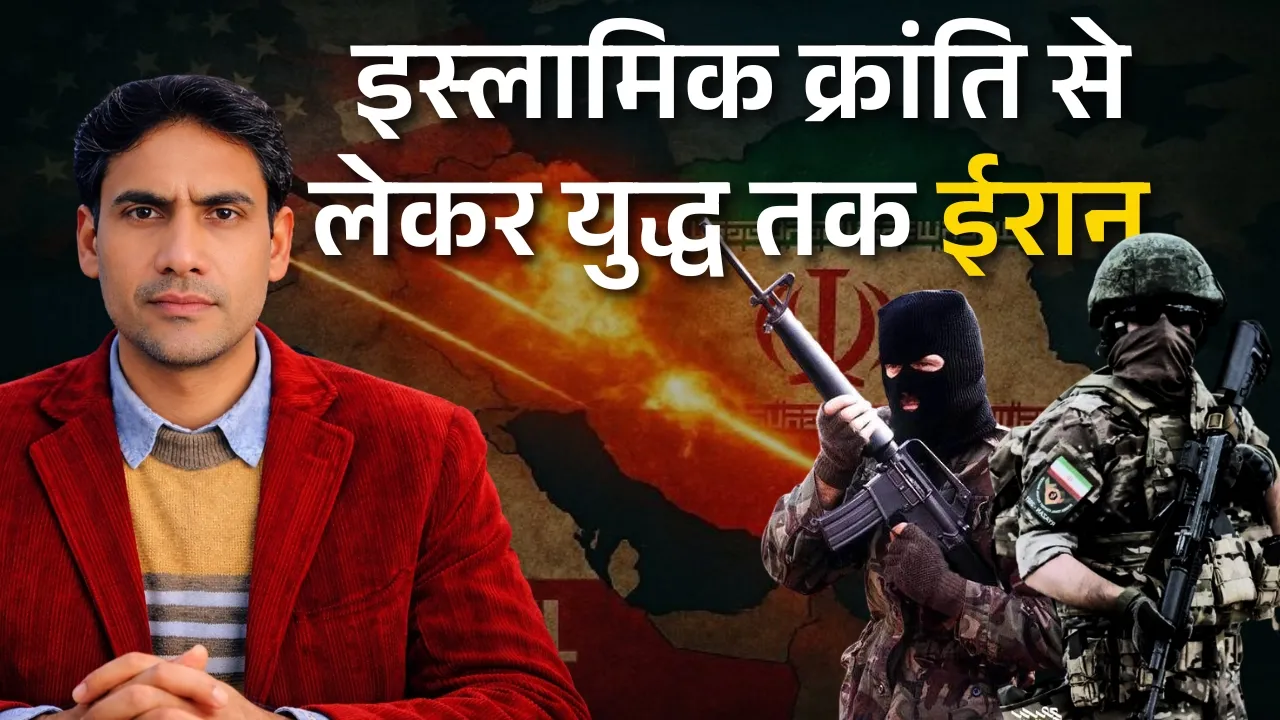
3. Conceptual Understanding of the Conflict
The Iran-Israel rivalry is best understood through several conceptual frameworks.
3.1 Ideological Conflict
The conflict is partly ideological:
Iran’s ideology:
Islamic revolutionary state
Supports Palestinian resistance
Rejects Israel’s legitimacy
Israel’s ideology:
Jewish democratic state
Emphasizes national security
Sees Iran as an existential threat
Thus, the conflict represents:
Islamist revolutionary ideology vs Zionist statehood.
3.2 Security Dilemma
International relations theory explains the conflict as a security dilemma.
Iran increases military capabilities → Israel perceives threat.
Israel launches preventive strikes → Iran feels threatened.
Both states interpret defensive measures as aggressive.
This cycle creates continuous escalation.
3.3 Balance of Power in the Middle East
Iran seeks regional dominance, while Israel aims to prevent hostile powers from dominating the region.
Iran’s regional strategy includes:
Expanding influence in Iraq
Supporting Hezbollah in Lebanon
Supporting Hamas in Gaza
Supporting Houthis in Yemen
Israel views this as encirclement.
3.4 Proxy Warfare
The Iran-Israel conflict has largely been fought through proxy groups rather than direct war.
Iran supports:
Hezbollah (Lebanon)
Hamas (Gaza)
Islamic Jihad
Iraqi Shia militias
Houthis (Yemen)
These groups attack Israel or its allies, allowing Iran to fight indirectly.
This strategy is known as asymmetric warfare.
4. Development of Proxy Conflict (1980s–2010s)
4.1 Hezbollah and Lebanon
In 1982, Israel invaded Lebanon.
Iran helped create Hezbollah, a Shia militant group.
Hezbollah became:
A powerful political party
A heavily armed militia
Iran’s most important regional ally
Israel considers Hezbollah its biggest military threat on the northern border.
4.2 Hamas and Palestinian Groups
Iran also supported Palestinian militant groups such as:
Hamas
Palestinian Islamic Jihad
These groups frequently engage in conflict with Israel.
Iran provides:
Funding
Training
Weapons
Missile technology
4.3 Syrian Civil War
The Syrian Civil War (2011 onwards) intensified Iran-Israel tensions.
Iran supported Syrian President Bashar al-Assad.
Iran deployed:
Revolutionary Guard forces
Shia militias
Weapons infrastructure
Israel conducted hundreds of airstrikes in Syria to destroy Iranian bases and weapons shipments.
5. Nuclear Issue
One of the most critical aspects of the Iran-Israel conflict is Iran’s nuclear program.
5.1 Iran’s Nuclear Ambitions
Iran claims its nuclear program is peaceful.
However, Western countries and Israel suspect Iran is trying to develop nuclear weapons.
Concerns include:
Uranium enrichment
Advanced centrifuges
Underground nuclear facilities
5.2 Israel’s Position
Israel considers a nuclear Iran unacceptable.
Israel has followed the “Begin Doctrine”, which states:
Israel will prevent hostile states from obtaining nuclear weapons.
Examples:
1981: Israel destroyed Iraq’s Osirak nuclear reactor.
2007: Israel destroyed Syria’s suspected nuclear facility.
Israel has also conducted covert operations against Iran’s nuclear program.
5.3 Cyber Warfare
One of the most famous cyber attacks was:
Stuxnet virus (2010)
Believed to be developed by Israel and the US.
Targeted Iran’s nuclear centrifuges.
This marked a new era of cyber warfare in international politics.
6. Escalation in the 2020s
The conflict intensified significantly in the 2020s.
Major developments include:
cyber attacks
targeted assassinations
drone warfare
missile strikes
In 2024, tensions escalated when Israel reportedly struck an Iranian diplomatic compound in Syria, killing senior Iranian commanders.
Iran retaliated by launching over 300 missiles and drones toward Israel, marking the first direct attack from Iranian territory.
This was a major shift from proxy conflict to direct confrontation.
7. The 2025 Iran–Israel War
In June 2025, tensions exploded into a brief but intense conflict.
Israel launched airstrikes on Iranian military and nuclear facilities, targeting nuclear scientists and military leaders.
Iran retaliated with missile attacks on Israeli cities and military bases.
Key facts:
Conflict lasted around 12 days
Hundreds of casualties
Major infrastructure damage
This marked the first large-scale direct war between the two countries.
Recent reports indicate:
Israel launched airstrikes on Iranian military targets, including airbases and aircraft facilities.
Iran retaliated with missile attacks on Israel and U.S. bases across the region.
The conflict has spread to several Middle Eastern countries, involving proxy groups and regional infrastructure.
Energy markets and global oil prices have been severely affected due to tensions near the Strait of Hormuz, through which about 20% of global oil supply passes.
The war has already caused:
Thousands of casualties
Severe infrastructure damage
Airspace closures
Disruption of global trade and aviation.
8. Key Strategic Dimensions of the Conflict
8.1 Military Capabilities
Highly advanced military
Nuclear weapons capability (undeclared)
Advanced air force
Iron Dome missile defense
Iran:
Large missile arsenal
Drone warfare capability
Proxy network across the Middle East
Revolutionary Guard forces
8.2 Role of Proxies
Iran’s strategy heavily relies on proxy militias.
Major Iranian allies include:
Hezbollah (Lebanon)
Hamas (Gaza)
Houthis (Yemen)
Iraqi Shia militias
These groups enable Iran to attack Israel indirectly.
8.3 Role of the United States
The United States is Israel’s closest ally.
Support includes:
military aid
intelligence cooperation
missile defense systems
During recent escalations, the US has helped intercept Iranian missiles and conducted strikes on Iranian targets.
8.4 Global Powers
Other powers also play roles:
Russia:
close relations with Iran
influence in Syria
China:
economic cooperation with Iran
energy partnerships
European Union:
supports diplomacy
attempts nuclear agreements
9. Economic Implications
The Iran-Israel conflict has global economic consequences.
Key impacts:
Oil Prices
Middle East produces a large share of global oil.
Disruptions increase:
oil prices
inflation
transport costs
Global Trade
Conflict threatens:
Strait of Hormuz
Red Sea shipping routes
These routes are essential for global energy transport.
Financial Markets
Wars create:
market instability
currency fluctuations
investment uncertainty
10. Possible Future Scenarios
Experts identify several possible future outcomes.
Scenario 1: Limited Conflict
Small-scale strikes continue but full war is avoided.
This is the most common historical pattern.
Scenario 2: Regional War
Conflict spreads to:
Lebanon
Syria
Iraq
Yemen
This would involve multiple proxy groups.
Scenario 3: Nuclear Crisis
If Iran develops nuclear weapons, Israel may launch preemptive strikes.
This could trigger a large-scale war.
Scenario 4: Diplomatic Settlement
International negotiations could:
revive nuclear agreements
reduce regional tensions
However, this scenario currently appears unlikely.
11. Significance for Global Politics
The Iran-Israel conflict affects:
Middle East security architecture
Global energy markets
US foreign policy
Great power competition
International nuclear non-proliferation
For India, the conflict matters because:
India imports oil from the Middle East
Iran is part of Chabahar port project
Israel is a major defense partner
Thus, India must maintain strategic balance.
14. Conclusion
The Iran–Israel rivalry is widely considered one of the most dangerous geopolitical conflicts of the 21st century. What started as an ideological confrontation after the 1979 Iranian Revolution has gradually developed into a complex struggle involving nuclear ambitions, regional power competition, proxy warfare, and wider global strategic interests.
For many years, both nations avoided a prolonged direct war, relying instead on indirect confrontations and strategic pressure. However, recent developments suggest that tensions are becoming more direct and increasingly militarized. The future trajectory of this conflict will significantly influence the stability of the Middle East as well as global political and economic dynamics.
At The Eklavya IAS Academy, understanding such international conflicts is essential for developing a deeper perspective on global politics and strategic affairs. Analyzing the Iran–Israel conflict requires not only historical awareness but also a strong understanding of international relations theory, regional geopolitics, and evolving global power dynamics.